


THE LEXICON
Precision · Clarity · Trust
The project
“Whatever we conceive well we express clearly, and the words flow with ease,” wrote 17th-century French poet Nicolas Boileau. Of course, you still have to find the right words - especially when expressing yourself in another language!
In the gem & jewellery trade, the terminology is as precise as the craftsmanship itself. It can be difficult to find equivalents across languages for certain techniques, tools, and areas of expertise. A translation that is too literal can quickly become imprecise or even misleading.
That is why AZ Jewels provides this multilingual lexicon free of charge.
It currently comprises over 4,400 terms in five languages: French, British and American English, Italian, Spanish, and German. The most extensive content to date covers French, English, and Italian.
The lexicon is an evolving project, progressively enriched with new terms, definitions, and (we hope) additional languages in the future, particularly Mandarin, as we have secured a particularly valuable Chinese technical dictionary.
We also aim to supplement the definitions with images or sketches. Since illustrating technical concepts requires careful attention to copyright, we are considering partnerships to eventually offer a resource that is as visually engaging as it is reliable.
Finally, the project is designed to rely on a scientific committee made up of industry professionals. Its role will be to help validate sources, ensure content accuracy, and oversee the lexicon’s ongoing development.
Whether you're at the bench or behind a screen, you'll find the words you need - from gouache design to final display. And if something’s missing, you can help us complete the picture by easily sending a suggestion directly directly in the program.
Sources
Building this lexicon took time and a lot of research. I consulted multiple sources: printed and online dictionaries, technical books, and cross-referenced materials.
I also drew from more personal archives, like friends’ notebooks from their time working in the UK and US. The generous advice of many peers helped shape and enrich this tool. What truly sustained the project was my own experience, and a genuine desire to create something useful for the trade.
If you know of a book, article, or website that could contribute to the lexicon, feel free to reach out, I’d love to hear about it.
The project began with two main sources: Elsevier and the Dizionario, both helpful, though not always precise. These early references offered word-for-word translations, but no definitions, and writing the definitions turned out to be the most demanding part of the process.
As for online resources, I’ve only listed below the most in-depth and reliable ones I came across.

Title: Elsevier's dictionary of jewellery and watchmaking : in five languages, English, French, German, Italian, and Spanish.
Author : Carl Forget
Publisher : Elsevier
Publishing date : 1984
Pages : 507
ISBN : 044442279X 9780444422798
Availability : Out of print - the editor was contacted he said they are not planning to print it again.
It lists words and expressions used in the fields of jewellery, gemology, gold- and silver-smithing, watchmaking, and related subjects. An interesting feature of this dictionary is the inclusion of many incorrect or illegal terms, which are in use in some countries, and which are often incorrectly mentioned in gem literature.

Title: Dizionario multilingue dell’oreficeria - in 7 languages: Italian, English, German, French, Spanish, Portuguese, Dutch.
Author : -
Publisher : Edizioni Polistampa
Publishing date : 2001
Pages : 372
ISBN : 8883043480
Availability : Amazon, La Feltrinelli
Unfortunately little known, the project was developed and coordinated by Gio Carbone for Le Arti Orafe - International Jewelry School in Florence. Cellini is a pilot project co-funded by the European Commission - Directorate General for Education and Culture, under the Leonardo Da Vinci Operational Program. The aim of the project was to create a multilingual dictionary of terms and concepts concerning the jewelry and jewelry sector, as a research and work tool but without definition.
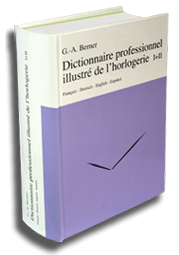
Title: Dictionnaire professionnel illustré de l'horlogerie
Author : G. A. Berner
Publisher : Fédération de l´industrie horlogère suisse
Publishing date : 1961
Availability : on-line and in print
This dictionary is specialised in watchmaking and also exists on-line via a website and an app (Android and iPhone). It is updated regularly and each term is translated from French to English, German and Spanish.
The Foundation High Horology developed its own on-line "Glossary of watchmaking" in French, English and Japanese.
AZ Jewels's lexicon in figures
4 412
words translated since 2017
5
languages to be fully developped
countless
hours of passionate
research
T E S T I M O N I A L S
"If our audit advisor managed to understand how to get on with our RJC certification documents, it's pretty much thanks to AZ Jewel's lexicon!"
A workshop CEO in Lyon, France.
"As a creative designer, I constantly make research on-line, be it technical or cultural. AZ Jewels has become a precious help, both for research as well as for translating notes and explanations that I give along with the gouache designs I provide for our foreign clients. "
A jewellery designer in Paris, France.
Get involved!
Our team may be small, but it’s driven and dedicated. We currently lack both time and funding to move faster, which is why we welcome all forms of support: advice, feedback, suggestions, and partnerships.
Several challenges are currently on the table:
-
A selection of jewellery-related terms (grouped by theme) would benefit from thorough review and proofreading.
-
Many word entries still need to be illustrated with images or sketches. Given the complexity of copyright, we see partnerships as the best way forward.
-
We are actively seeking volunteers to help with additional Spanish and German translations.
Supporting this project isn’t just about funding. Your time, your expertise, and your network can all make a difference.
We are also running three ongoing projects that are equally important and would greatly benefit from external contributions.
Here they are:

Creating a Scientific Committee
Building trust means being rigorous. We plan to form a Scientific Committee to reinforce the credibility of the lexicon and guide its evolution. If you’re a professional and would like to be involved — we’d love to hear from you.


Developing new tools
Tools are what turn knowledge into action.
We’ve received many great ideas from users and partners — but bringing them to life will require time, expertise, and support. We are happy to contribute to the trade's growth !
Completing the lexicon
Finalising all definitions in English, French and Italian is our current priority — but expanding and improving content in other languages is just as crucial. There’s still a lot to do, and every contribution helps — feel free to reach out.
In order to sustain the free access to the lexicon, you may contact us to donate or to become a sponsor. Would you like to know more or participate in our linguistic adventure? Here's what to do:
→ Get in touch, share your ideas, offer your skills, or simply spread the word — every gesture helps the project grow.